
Exeter Cathedral is a site of worship and wonder for any visitor to the city, its renaissance architecture representing centuries of Christendom dominating both city and skyline. But the building’s main function has now departed from a source of religious power to one as host of a Christian creative network which spans Exeter and beyond.
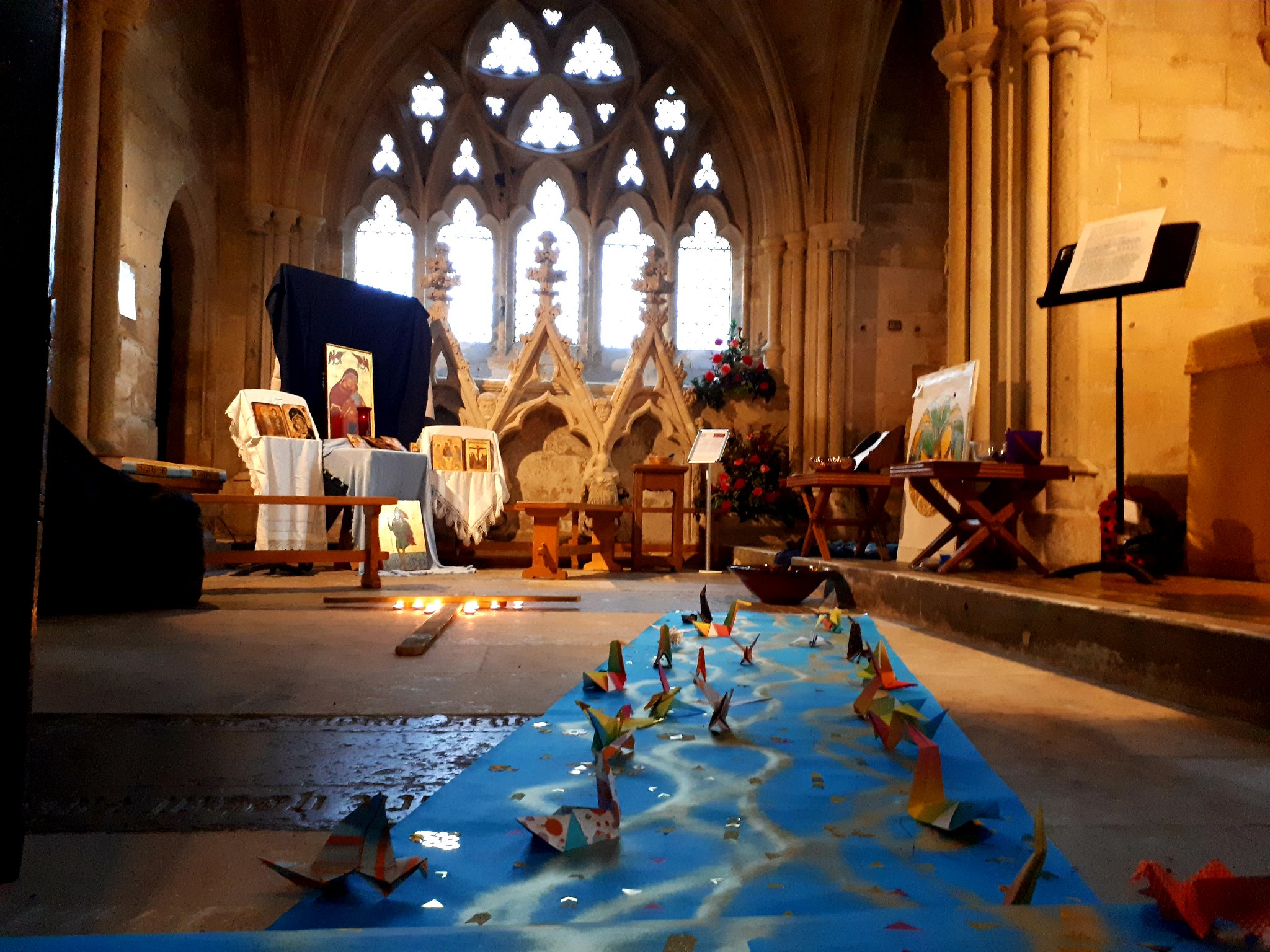
‘Thy Kingdom Come’ is an annual celebration of prayer, spatially anchored in the Diocese of Exeter to bring together Christians from any background in the area, each with a stall to creatively express and engage visitors with prayer (such as below).


https://engageworship.org/ideas/courage-prayer-stations
As networks mobilise “intersecting relationships through which ideas are recombined and capabilities are nurtured”[1], the Cathedral makes visible what otherwise remains a hidden and untapped collection of Christians, through active knowledge or style exchange.[2] As the Church of England operates as the core actor, periphery actors of the network (smaller, less influential Churches around Exeter) are invited to inject divergent ideas through a recognition of joint agency.[3] The basis of network creativity therefore is the use of existing connections within the city, allowing interpersonal relationships across space resulting in big ideas greater than the sum of its parts.[4]
In doing so, Thy Kingdom Come, as a manifestation of collective believers in a locale, creates an atmosphere in which “high levels of interaction conducive to creativity” occurs.[5]A Cathedral full of people sharing beliefs, core values and love for God and one another forges not only ‘new’ (or rather, previously unseen) ideas, but also a creative social milieu.[6] The ‘buzz’ factor of when networks are called on in a big open space is exciting; experiencing innovation from so many diverse areas and walks of life is a perfect antidote to stagnation and boredom, a chance to peep over the echo chamber of the same.[7]
And whilst Exeter Cathedral draws on local networks within a specific geographical situatedness, Thy Kingdom Come flows out of the building and the city into a global network of Christians, infinitely multiplying ideas and creativity in prayer and expressions of faith [see links below].
https://exeter.anglican.org/christian-faith/tkc/
https://www.thykingdomcome.global/about-us
As networks bind the individual to a newfound collective[8], so the event ended with the doors of the Cathedral being opened and many huge colourful fabrics being hoisted by every member out of the doors and onto the plaza before the building, symbolising the Holy Spirit’s ever-reaching and unifying power as a kind of heavenly network of its own:

Binded by the Holy Spirit, the Bible says this of Christian networks:
As iron sharpens iron,
Proverbs 27:17
so one person sharpens another.
So the creative network of Churches in Exeter becomes a physical and visible indication which echoes their spiritual network. By mobilising such an important, historical, pre-existing network in a place such as Exeter, powerful and inspiring results come to fruition.
References
Brennan – Horley, C. (2010) Multiple work sites and city-wide networks: a topological approach to understanding creative work, Australian Geographer 41:1 pp 39-56, Routledge
Cattani, G.; Ferriani, S. and Colucci, M. (2015) Creativity in Society Networks: A core-periphery perspective in Jones, C.; Lorenzon, M. and Sapsed, J. The Oxford Handbook of Creative Industries, Oxford University Press
Drake, G. (2002) ‘This place gives me space’: place and creativity in the creative industries, Geoforum 34 pp 511-524
Harvey, D.C.; Hawkins, H. and Thomas, N.J. (2012) Thinking Creative clusters beyond the city: People, places and networks, Geoforum 43, 529-539
O’Regan, T.; Gibson, L.; Jeffcutt, P. (2004) Creative Networks, Culture and Policy no 112 pp 5-8 in Media International Australia
[1] Cattani et al. 2015:1
[2] Harvey et al. 2012
[3] Cattani et al. 2015
[4] Brennan-Harley 2010
[5] Drake 2002:522
[6] Harvey et al. 2012
[8]Harvey et al. 2012
 GEO3131